


04/11/2021
Without Local Entities, the goals set in the 2030 Agenda will not be achieved.
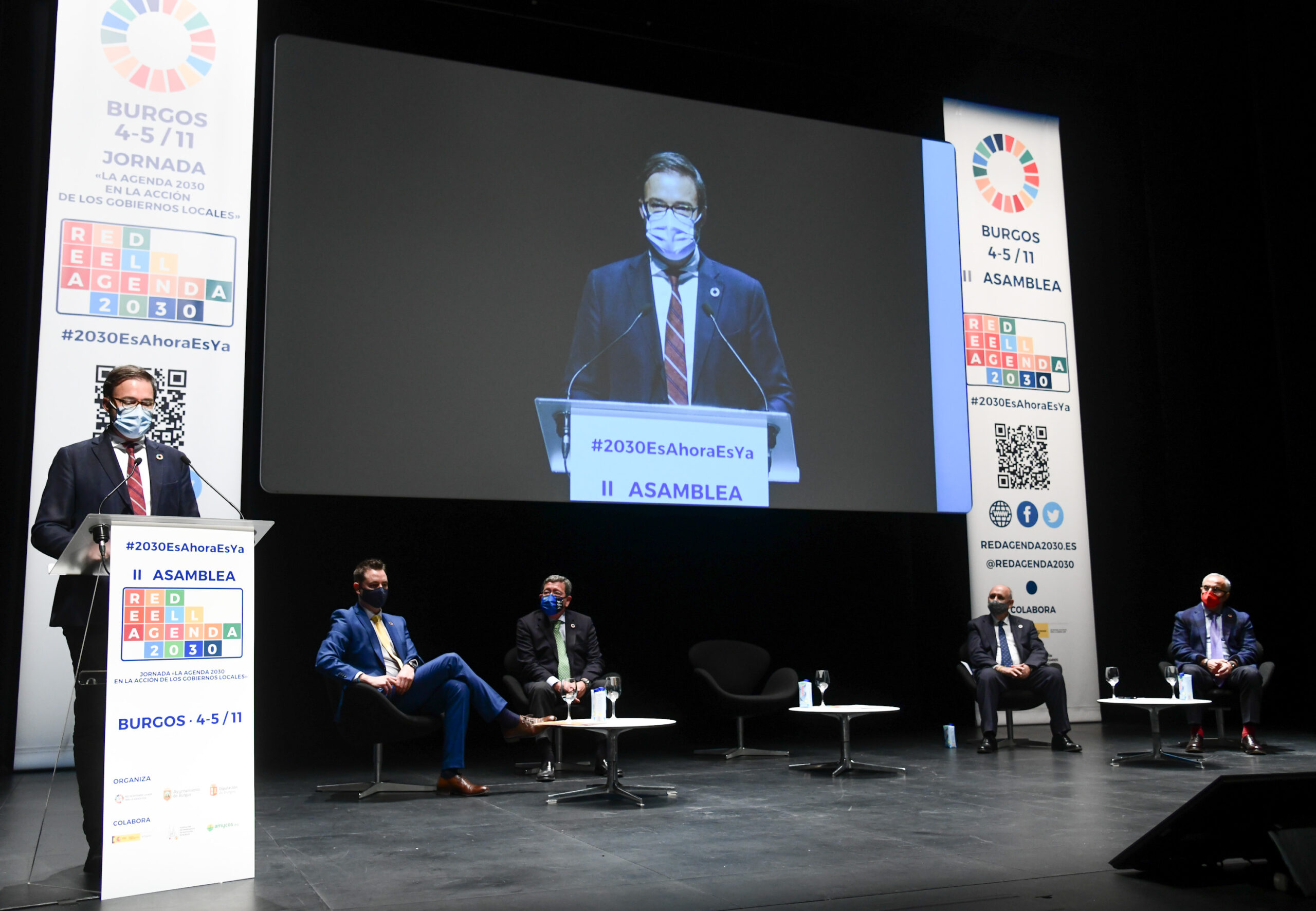
The opening of the conference “The 2030 Agenda in the Action of Local Governments” featured speeches by the Secretary General of FEMP, the Mayor of Burgos, the President of the Provincial Council, the Secretary of State for the 2030 Agenda, the Mayor of Palma and President of the Network of Local Entities for the 2030 Agenda of FEMP, and the President of the COE
All of them agreed that the path towards the SDGs of the 2030 Agenda requires the direct involvement of Local Governments
The conference, organized by the Network of Local Entities for the 2030 Agenda of FEMP, will take place in Burgos today and tomorrow
Burgos, November 4, 2021.- “Without the direct involvement of Local Governments in achieving the SDGs, the set goals will not be met.” This was highlighted by the Secretary General of FEMP, Carlos Daniel Casares, during his address at the opening ceremony of the conference “The 2030 Agenda in the Action of Local Governments,” which is being held in Burgos from today until tomorrow midday, with over three hundred participants both in-person and remotely.
Casares referred to the importance of network collaboration as an “integrator of local power,” also emphasizing the importance of cooperation with other Administrations, institutions, and the private sector, and welcomed the upcoming arrival of European Funds for recovery. In his opinion, it is at the local level that the use of these funds can ensure an equality approach and the implementation of measures that reach everyone and all territories to improve people’s lives. The Secretary General of FEMP, who also highlighted the opportunities to promote projects and opportunities in rural areas with these funds, recalled the demand for new local regime regulations and fair local financing as “FEMP reaches its maturity, celebrating 40 years since its establishment.”
For the host Mayor, Daniel de la Rosa, the members of the Network are “cities committed to the Sustainable Development Goals,” and he added that, although “the 2030 Agenda is no longer unknown, the time for action has come,” to change ways of doing politics to ensure sustainability. In Burgos, the 2030 Agenda “has been incorporated as a roadmap.” “The 2030 Agenda at the local level identifies us as the main actors from proximity,” he said.
In his speech, De la Rosa positively assessed the Recovery, Transformation, and Resilience Plan and assured that “we are at a point of no return, and we cannot miss these opportunities presented to us to incorporate more sustainable investments.”
For his part, the President of the Provincial Council, César Rico, alluded to the importance of sensitivity to the commitment undertaken by the United Nations with the SDGs, 17 goals and 169 targets. He also referred to FEMP’s leadership in working with these objectives and advocated for the role of Provincial Councils, stating, in the Spanish province with the most municipalities, that “Provincial Councils must lead this process to seek territorial balance between urban and rural areas.”
José Hila, Mayor of Palma and President of this FEMP Network, stated that “without us, the 2030 Agenda is not possible.” In his opinion, FEMP was right to propose the creation of a Network like this as a priority objective to work on the SDGs of the 2030 Agenda: “Municipalities are good at working together,” and the Network is the place for that. He highlighted that, in a year and a half, “we are the network with the most affiliated partners,” 363 entities, of which 333 have registered for the conference.
Hila, who positively assessed the holding of this first in-person assembly of the Network, also highlighted the importance of the Spanish Olympic Committee (COE) joining as a partner, “to collaborate in the implementation of the SDGs in a field as relevant as sport.”
For his part, the Secretary of State for the 2030 Agenda, Enrique Santiago, sent his welcome message to the Conference via video, emphasizing that for the Secretariat of State, the role of Local Entities in the SDGs is fundamental, because all of them include issues that fall within local responsibility. “The 2030 Agenda means working day by day for the well-being of citizens, the sustainability of the planet, and in this daily work, Local Administration plays a fundamental role due to its capacity to apply public and tangible policies.”
Enrique Santiago recalled the Executive’s commitment to the 2030 Agenda by referring to the Strategy and highlighting the planned contributions in budgets, among others, one that includes a specific call to reinforce the work of localizing the 2030 Agenda. He also expressed the will to contribute to FEMP’s work to offer tools that support action and the exchange of knowledge and good practices to advance towards the SDGs, “which are useful because they improve people’s lives and daily routines.”
Alejandro Blanco, President of the Spanish Olympic Committee (COE), who joins as an observer partner of the Network, assured that sport is much more than competing and that “talking about sustainability is talking about sport in capital letters.” Regarding the COE’s incorporation into the Network, he pointed out that this organization considers sustainability one of the basic pillars of the global sports movement, “in fact,” he clarified, “the great basis for hosting the Olympic Games is sustainability, the capacity to organize sustainable events,” and he explained the actions promoted by the Committee to strengthen sustainability. “It is in the COE’s sustainability strategy where we want to be your companions, on this long and promising path, with a sustainable world as the goal. We have a great future that, if we are able to work together, will be our great legacy.”
The conference, organized by the Network of Local Entities for the 2030 Agenda of FEMP, the Burgos City Council, and the Provincial Council, will feature contributions from local officials and experts who will debate in panels and round tables on the keys to advancing the 2030 Agenda from municipalities and provinces, the importance of inter-institutional coordination to accelerate the bottom-up implementation process of the SDGs, the opportunities of the 2030 Agenda as the axis of local policies, and also on the necessary agents in the local implementation of the 2030 Agenda. After these sessions, the II Assembly of this FEMP Network will be held tomorrow, Friday.


