

Good practices
Practical guide for the localization and implementation of the 2030 Agenda in small municipalities in the province of Burgos
Provincial Council of Burgos
Summary
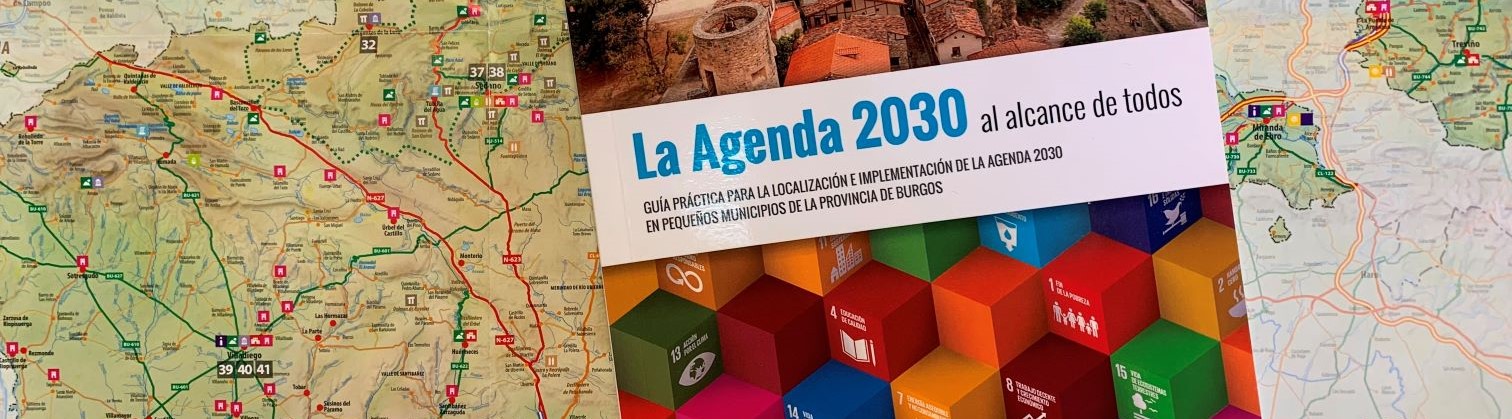
In this publication, validated by the FEMP itself, existing methodologies for the local implementation of the 2030 Agenda (awareness-raising, local diagnosis, localization plan, measurement and monitoring plan, etc.) have been duly adapted to the true scope and needs of small municipalities. In fact, several town councils in the province collaborated in its preparation (Frías, Caleruega, Belorado, Tordómar) by studying and adapting their municipal reality to this new language of sustainability.
The Guide was officially presented on March 30, 2023, during a training session held in the Assembly Hall of the Monastery of San Agustín (Burgos). The event was attended by nearly a hundred municipal representatives from all regions of the province and featured presentations by technical experts in the integration of the 2030 Agenda into local policies. The session and the document itself sparked enormous interest among the province’s town councils, many of which showed receptivity toward starting the implementation process of the 2030 Agenda.
During the training and presentation session, approximately 120 hard copies of the Guide were distributed among the attending municipalities, and the remaining printed copies (up to 400 in total) have been subsequently distributed among the rest of the municipalities and other administrations interested in its content.
Project Classification
This is a Plan to facilitate the localization and implementation of the 2030 Agenda in small municipalities in the province of Burgos.
Timeline
June 2022 – June 2023
Self-assessment block
PLANNING: What were the objectives set for the project?
Aware of the needs of small municipalities and the management difficulties caused by a lack of resources, the Provincial Council sought to duly adapt existing methodologies for the local implementation of the 2030 Agenda to the true scope and needs of the majority of local governments in this province (population under 500 inhabitants and, in many cases, under 200 inhabitants) from a perspective that is easily understandable and achievable for all municipal officials.
IMPACT: What are the positive impacts of the project?
The guide represents a true management tool that invites our mayors to implement the 2030 Agenda in small municipalities in a simple and effective way, thereby facilitating the fulfillment of the SDGs in the province.
While awaiting specific results from the application of the guide, the expected impact is an increase in the contribution of municipalities to the SDGs and the widespread implementation of the 2030 Agenda in the local entities of the province of Burgos, as well as in other territories that wish to use it.
INNOVATION: What are the most innovative aspects? What challenge/problem is addressed?
This initiative is primarily aimed at internal reorganization or restructuring in town councils with fewer than 500 inhabitants, adapting our procedures and work methodologies to the principles set out in the 2030 Agenda (for example, localization of the A2030, design of implementation plans or alignment of existing plans with the A2030, budgetary alignment, identification and construction of measurement indicators, etc.).
METHODOLOGY: What methodology was followed for its implementation?
No specific methodology was used.
CONDITIONING FACTORS: What conditions must be met for the project to be successfully replicated (in a similar context)?
Realistic adaptation of implementation methodologies to small municipalities, collaboration from specific small municipalities that have served as examples, and the pursuit of alliances (FEMP, Regional Government of Castilla y León, media).
REPLICABILITY/SCALABILITY/TRANSFERABILITY: What elements should be considered for the project to be replicated in another Local Entity?
Detailed analysis of the territorial reality of each location, search for joint solutions with municipal officials, and involvement of higher administrations.
RESOURCES: What technical, human, and economic resources were used?
The initiative was carried out through a minor contract (final amount of €9,850), working with an external consulting firm.
Internally, the initiative was led by a technician from the Provincial Council (dsantillan@diputaciondeburgos.es).
STAKEHOLDER INVOLVEMENT: Which local stakeholders were involved in the project (citizens, third-sector organizations, private sector, academic field, etc.)? How was this involvement achieved?
Several town councils in the province collaborated in the preparation of the Guide (Frías, Caleruega, Belorado, Tordómar) by studying and adapting their municipal reality to this new language of sustainability.
INTERNAL COORDINATION: How was the project coordinated internally within the Local Entity?
Design of the Guide, drafting of the document, search for alliances, and presentation and distribution of the Guide.
ALLIANCES: Have other institutions been involved in achieving the set objectives?
Yes. We received a grant to finance or co-finance the initiative.
RESULTS/MEASUREMENT: Have the project results been measured based on local indicators?
Based on the number of small municipalities that have established an initiative to begin the implementation process.
TRIPLE IMPACT: Is the project sustainable from an environmental, economic, and social perspective?
The implementation of the 2030 Agenda in small municipalities represents, in itself, a proposal in the broadest sense to achieve triple balance.
OBSTACLES: What were the main obstacles encountered in all phases of the project?
Reluctance of municipal officials to start the process
Information block
FURTHER INFORMATION
The Guide is available in electronic format on the Burgos Provincial Council website:
View more casesLocal Entity name: Provincial Council of Burgos
Province: Burgos
Autonomous Community: Castile and León
Number of inhabitants: From 100,001 to 500,000 inhabitants
Contact person: Diego Santillán García Environmental Technician
Contact telephone:947 258 600
Email:dsantillan@diputaciondeburgos.es
SDGs involved: