

Good practices
2023 Municipal Environmental Education Program
Villamayor City Council
Summary
This initiative aims to encourage Villamayor’s citizens to take an active stance on the issues affecting this locality. Understanding these problems facilitates reflection and the search for solutions which, now more than ever, must be shared between the Administration and the citizens themselves.
It is important to establish a link between all campaigns and actions programmed annually by the Villamayor City Council, providing them with programmatic coherence, so that they help citizens better understand the actions undertaken, as well as the services offered.
Project Classification
It is a Program. Dissemination/awareness-raising actions for the 2030 Agenda among citizens.
Timing
Start: January 1, 2023. End: December 31, 2023
Self-assessment Block
PLANNING What were the objectives set for the project?
The 2023 ENVIRONMENTAL EDUCATION PROGRAM of Villamayor is conceived with the general objective of facilitating the encounter of urban society with its surroundings, providing educational and/or recreational activities that use the individual’s own living space and their closest urban/natural environment as their field of action, always with a focus on achieving effective sustainable development.
INNOVATION What are the most novel aspects of the initiative?
This initiative is primarily aimed at satisfying one or more needs of the population in our territory in relation to one or more axes of the 2030 Agenda (People, Planet, Prosperity, Partnerships).
Which target population is it aimed at?
Due to its nature and function, municipal environmental education programming concerns all of society and should be directed at all members and groups, taking into account the needs, interests, and motivations of the different age groups and socio-professional categories within the municipality of Villamayor.
METHODOLOGY What methodology was followed for its implementation?
All coordination levels have been carried out by the Municipal Environmental Service, through the coordination of the Environmental Technician and in collaboration with the environmental, economy, education, and culture departments, in addition to the Mayor’s Office.
CONDITIONING FACTORS What conditions must be met for the project to be successfully replicated (in a similar context)?
– Involvement of most active sectors in the municipality.
– Coordination by specific, dedicated staff within the municipal workforce.
– Prior existence of a network of social connections among the different sectors of the population.
REPLICABILITY/SCALABILITY/TRANSFERABILITY What elements should be considered for the project to be replicated in another Local Entity?
– Availability of dedicated staff (at least one person with environmental education training and programming experience).
– Involvement of the municipal corporation (governing team) to promote dissemination and local participation.
– Involvement of associative movements and educational centers in the municipality.
RESOURCES What technical, human, and economic resources have been used?
– Technical Resources: Full availability of the Municipal Environmental Technician and the resources available in their department.
– Human Resources: Inter-departmental collaboration to promote participation and dissemination of actions. Availability of the green areas and street cleaning departments to collaborate in required actions. Participating staff, both teaching and students, from the training and employment workshop “Waste Management and Environmental Education.”
– Economic Resources: €5,000 annually.
STAKEHOLDER INVOLVEMENT Which local stakeholders have been involved in the project (citizens, third sector organizations, private sector, academic sector, etc.)? How was this involvement achieved?
The most involved stakeholders, with whom a consolidated collaboration network exists across all municipal sectors, have been:
– Coordination from the municipal environmental department with the Library, green areas, and street cleaning sections.
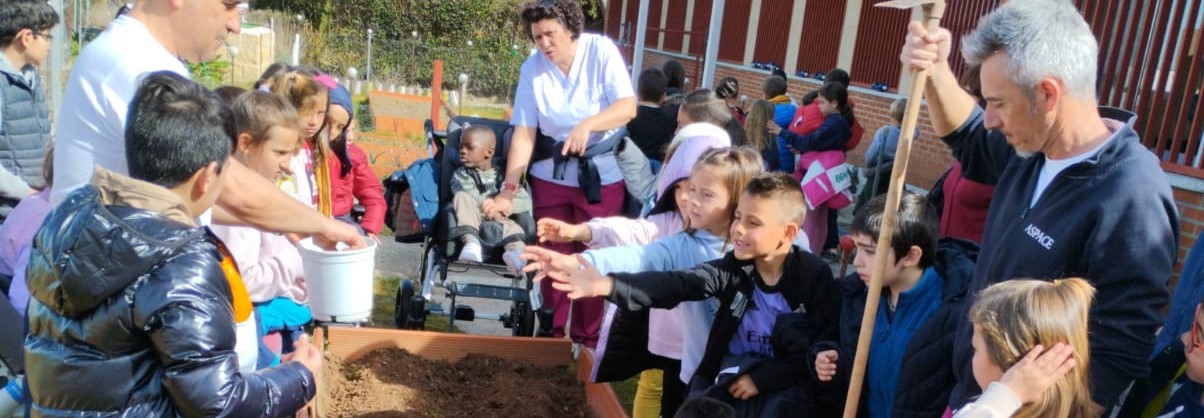
– Educational centers: “El Camino” Special Education School (ASPACE).
– Local environmental education companies: Aquila Medio Ambiente, Emberiza, Fundación Luna, Miguel Blanco Sol.
– Local initiative “City of Children”.
– Training workshop for employment: “Waste Management and Environmental Education.”
Briefly, what role has each played or is playing?
The Library section annually develops an extensive and carefully planned program that transversally addresses issues affecting our daily lives: education, gender equality, sustainable development, equitable development… And the green areas and street cleaning sections.
INTERNAL COORDINATION How has the project been coordinated internally within the Local Entity?Can you tell us what the main actions developed by the initiative have been?
– Citizen coexistence campaign for pet care in the urban environment.
– International Tree Day.
– Earth Hour with WWF.
– Recycling Roulette with the Salamanca Provincial Council.
– World Environment Day.
– European Mobility Week.
– Campaign aimed at educational centers: Recycling and waste reduction.
– Campaign aimed at USAL centers in the municipality of Villamayor: Composting and vermicomposting.
– Campaign for the reduction of wet wipe use.
– Collaborations with the municipal programs of City of Children, municipal library, and municipal Youth Center.
PARTNERSHIPS Have other institutions been involved in achieving the set objectives?
No
Has the implementation of the initiative involved local stakeholders outside the local corporation?
Yes
If you answered affirmatively to the previous question, could you indicate the process followed to achieve the involvement of the different stakeholders?
– Dynamization of citizen participation, involving local associations and businesses through the intervention of the municipal Environmental Technician.
– Involvement of the municipal corporation in disseminating the program’s initiatives on social media and within the municipality.
– Involvement of other municipal sections in the initiatives to be executed, such as the municipal Library, gardening service, or street cleaning service.
– Involvement of the waste management and environmental education training workshop.
– Involvement of the three municipal educational centers: City of Children, Piedra de Arte, and “El Camino” Special Education Center ASPACE.
Is there any participation body or established structure with the different stakeholders?
Verbal agreements, minor contracts, and others.
RESULTS/MEASUREMENT Have the project results been measured based on local indicators?
Results have been measured through satisfaction surveys, the number of participants, and the number of residents included in the actions.
TRIPLE IMPACT Is the project sustainable from an environmental, economic, and social point of view?
Since 2006, when the former Local Agenda 21 initiative was implemented in the municipality, not only was the triple impact of these areas considered when programming activities, but it was also established transversally, taking it into account when preparing or designing actions in any field of work of the Villamayor City Council.
OBSTACLES What have been the main obstacles encountered in all phases of the project?
– Lack of participation from sectors that demand this type of action.
– Understanding the cross-cutting nature of the actions.
– Greater budgetary and resource dedication in programming.
CONCLUSION. Project impact and utility.
To ensure that Villamayor’s citizens take an active stance on the issues affecting this locality. Understanding these problems facilitates reflection and the search for solutions which, now more than ever, must be shared between the Administration and the citizens themselves.
Deepening the concept of Sustainable Development, integrated across all City Council actions, will serve as the general framework for activities within this Program.
Information Block
FURTHER INFORMATION
The website can be consulted:
https://www.villamayor.es
View more cases
Local Entity name: Villamayor City Council
Province: Salamanca
Autonomous Community: Castile and León
Number of inhabitants: From 5,001 to 10,000 inhabitants
Contact person: Ángel Luis Peralvo Sanchón Mayor
Contact Phone: 923 305 605
E-mail: angel@villamayor.es
SDGs involved: