


04/11/2021
Involve, act, and evaluate: keys to local action for the 2030 Agenda
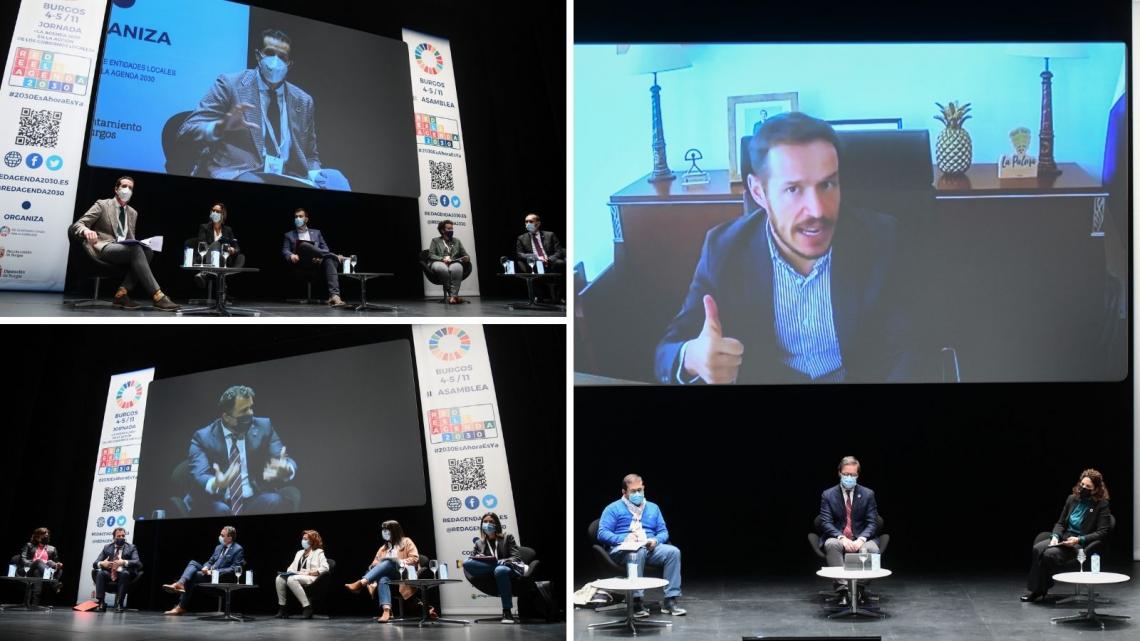
The FEMP Conferences in Burgos reviewed local action and its challenges to fulfill the 2030 Agenda
Burgos, November 4, 2021.- Local Entities face the challenge of translating the 2030 Agenda to engage citizens as accomplices in the work to achieve an economically, socially, and environmentally sustainable society. Furthermore, they must never lose sight of the need to evaluate and measure this city-wide work to know what is functioning and to share it. These are some of the conclusions drawn from the three panels of the first session of the Conference “The 2030 Agenda in Local Action in Local Governments”, a space for “sharing and learning” organized by the FEMP Network of Local Entities for the 2030 Agenda, the Burgos City Council, and the Burgos Provincial Council.
The first session, moderated by the Second Vice President of the Network and Mayor of Elda, Rubén Alfaro, was dedicated to the ‘Keys to advancing the 2030 Agenda from Municipalities and Provinces’. It featured representatives from the three State Administrations: the Director General of Lever Policies for the Fulfillment of the 2030 Agenda, Gabriel Castañares; the Minister of the Presidency of the Principality of Asturias, Rita Camblor; the Mayor of Cáceres, Luis Salaya; and the Mayor of Onda, Carmina Ballester.
During the debate, it became evident that the 2030 Agenda speaks “of reality” and that there is no “Administration closer to reality than the local one.” Thus, Castañares highlighted that the United Nations has given “an essential role to municipalities for the implementation of the Agenda,” which must be “built from the everyday, from collaboration with those who ‘know because of their proximity’, and those who have the capacity to turn ‘an SDG target into something concrete and tangible’.”
“You are indispensable,” Camblor stated during her intervention, affirming that the 2030 Agenda is not a “theoretical text” but represents real problems and marks “a path” that we must “plan” and “evaluate” together. Along these lines, the Minister emphasized the need for “Governments, from every Administration, to be in continuous contact and constant cooperation.” At the local level, the Mayor of Cáceres and the Mayor of Onda agreed that “leaving no one behind is not a slogan, it is a duty.”
Salaya, President of the FEMP Commission for the SDGs of the 2030 Agenda, assured that working on sustainable development means “breaking harmful dynamics and empowering the most vulnerable population,” a challenge that requires reaching everywhere, something that “will only be possible through alliances.” For her part, Carmina Ballester highlighted the need to “believe, apply, and communicate” the SDGs because “little by little, drop by drop, we bring sustainability to the citizens.” To conclude the panel, Luis Salaya noted that the Administration is speaking in “SDGs,” a language that breaks “any barrier.”
The next panel began by asserting that “the 2030 Agenda is the basis of the new social contract.” This was stated by its moderator, Federico Buyolo, former Director General for the 2030 Agenda. He noted that “City Councils do not create the SDGs, although we have been working on them since before they existed. The SDGs are created and achieved by society.” This was affirmed by the Mayor of Palma and President of the Network, José Hila, who emphasized the need to “inform, involve, and localize” the challenges of the 2030 Agenda from the local level.
A regional government was also represented on this panel, specifically the Andalusian one. Its representative Carmen Cardosa, Vice-Minister of the Junta, stated that “territorial coordination and the mapping of resources and competencies are essential to address the fulfillment of the 2030 Agenda.” Furthermore, she explained, “it is being encouraged that projects submitted for Junta grants be aligned with the Agenda,” so that “those requesting public funds immerse themselves in this common challenge.” Before concluding her intervention, she highlighted the need to move forward with unity “on the path of the Agenda (…) to promote dialogue such as that enabled by the FEMP Network for the 2030 Agenda.”
The panel concluded in La Palma, a few minutes before the Emergency Committee coordinating actions for the Cumbre Vieja volcano took place. The President of its Cabildo, Mariano Zapata, connected with Burgos to give “thanks to all the Local Entities for accompanying the island in these hard times, because we have never felt alone.” After the expression of gratitude, Zapata, Vice President of the FEMP Commission for the 2030 Agenda, assured that the disaster suffered by La Palma is also an opportunity “to have more sustainable neighborhoods and housing, always applying the objectives of this Agenda.” For this challenge, the President stated that multi-stakeholder alliances must be applied so that these projects are sustainable and effective.
The afternoon panel, dedicated to analyzing the ‘Opportunities of the 2030 Agenda as a cornerstone of local policies’, was moderated by the Vice President of the Network and Mayor of Villarramiel (Palencia), Nuria Simón. It featured Pedro del Cura, Mayor of Rivas-Vaciamadrid; José Ortiz, Mayor of Torremolinos; María Gómez, Provincial Deputy of the Alicante Provincial Council; Iria Lamas, Provincial Deputy of the Pontevedra Provincial Council; and Nuria Parlón, Fourth Vice President of the Barcelona Provincial Council.
“We have no time left,” stated the Mayor of Rivas Vaciamadrid, Pedro del Cura. Furthermore, he recalled that what the 2030 Agenda encompasses “is not new to the local world; there is much work done and much to do.” Thus, he encouraged Local Entities to continue contributing “honestly” because the key to working on the 2030 Agenda, according to him, “is to carry out reliable diagnoses and for each Administration to reach as far as it knows it can.” Despite the good will existing in the local world, he asserted, “we must make a turn; we must provide resources and local commitment. If we act without tools that work, we do not transform the territory, we merely mask it.”
This panel also highlighted the work of Provincial Councils in “permeating everyone with the values of the 2030 Agenda.” Indeed, the Provincial Council is “the soul of small municipalities,” as stated by María Gómez from the Alicante Provincial Council; or, as the Fourth Vice President of the Barcelona Provincial Council said, they have a double role: “to accompany and support other municipalities and to act in alignment with the 2030 Agenda.”
Gómez also took the opportunity during her intervention to state that “without a budget, these actions cannot be carried out.” Along these lines, the Mayor of Torremolinos, José Ortiz, recalled that “the second decentralization” must be carried out, as “we want the resources and competencies to make the major transformations we are willing to undertake.” Furthermore, Ortiz stated that “we must resolve major challenges such as water and energy; if this is not done, we will not be able to make either the city or the economy sustainable.”
The Deputy of Pontevedra, Iria Lamas, also participated in the debate, reviewing the gender equality measures of her Local Entity with a call for the work on the 2030 Agenda to be a task “to empower women, to make their talent visible, and to do so as a shared struggle, hand in hand with men, as a job for the whole of society.” Furthermore, Lamas highlighted that “the Urban Agenda and the 2030 Agenda go hand in hand.”
“Alliances to contaminate, in the good sense of the word, the entire social magma with the logic of this Agenda.” That was the proposal from the Fourth Vice President of the Barcelona Provincial Council, who highlighted that the “2030 Agenda allows us to dream with our feet on the ground, transforming society from the Local Administration.” During her intervention, Parlón requested “that the immediate and the essential do not make us forget the importance of aligning local action with the SDG targets.”
Tomorrow, the panel ‘Necessary agents in the local implementation of the 2030 Agenda’ and the II Assembly of the Network will take place, which can be followed live: http://youtu.be/Fg0hHpbCwyw


