


20/10/2021
The Canary Islands move toward the SDGs with a guide to promote and evaluate the 2030 Agenda at island and local levels
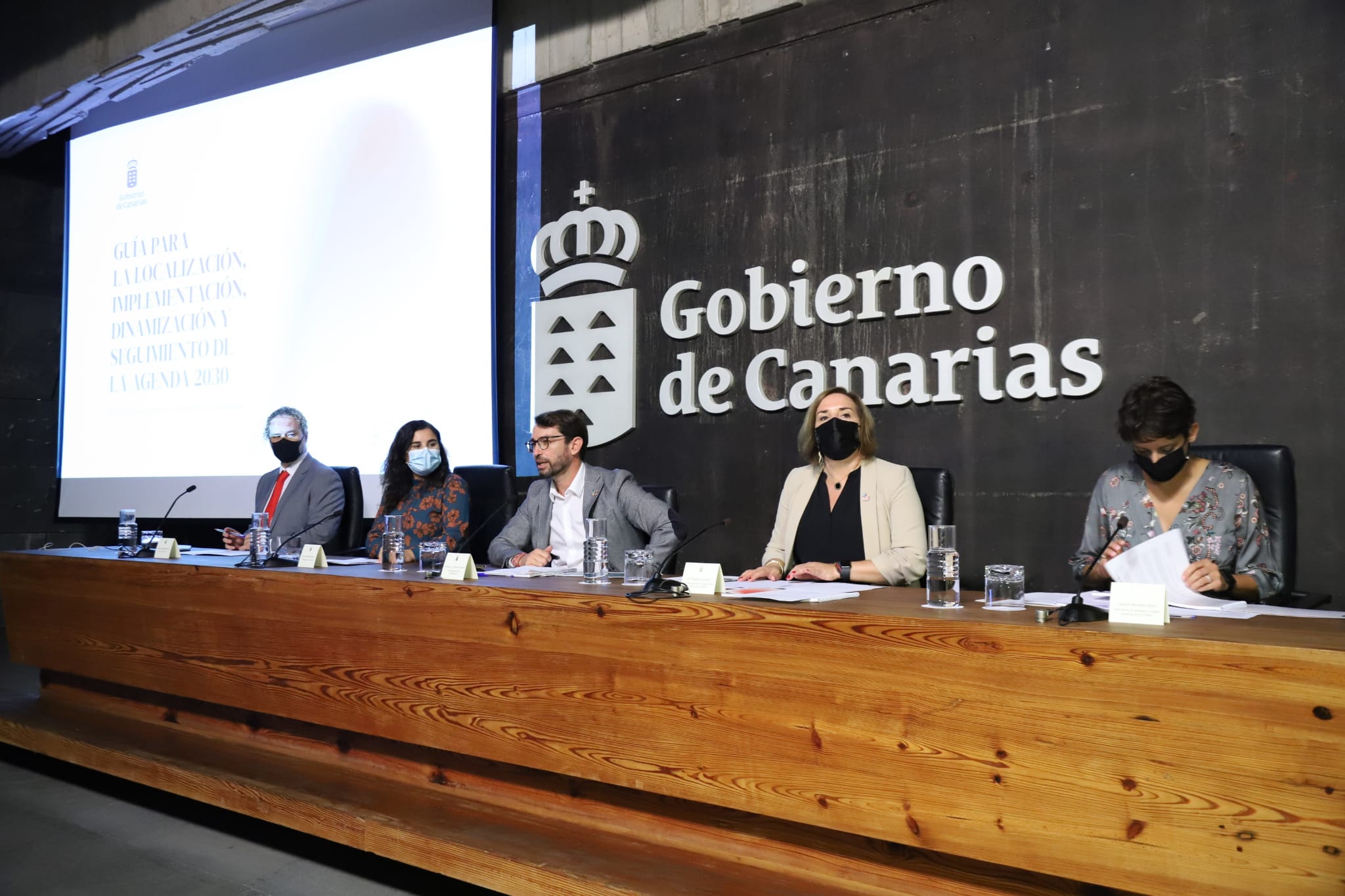
The Presidency headquarters in Santa Cruz de Tenerife hosted this morning the presentation of the “Guide for the Localization, Implementation, Revitalization, and Monitoring of the 2030 Agenda,” featuring representatives from the island councils and the town halls of the Islands.
The Director General of Research and Coordination of Sustainable Development of the Community, David Padrón, highlights the “growing participation” of public and private agents and reiterates that the Canary Islands 2030 Agenda will be approved during the remainder of 2021.
Santa Cruz de Tenerife, October 20, 2021.- The Government of the Canary Islands continues to take steps in its commitment to sustainable development and this morning presented the Guide for the Localization, Implementation, Revitalization, and Monitoring of the 2030 Agenda by these institutions to the island councils and city councils of the Islands. The session took place at the Presidency headquarters in Santa Cruz de Tenerife and served, among other matters, to underline the crucial role that these corporations play in the processes of contextualizing said agenda and in promoting and fulfilling the 17 Sustainable Development Goals (SDGs) of the United Nations (UN).
The Director General of Research and Coordination of Sustainable Development of the Government of the Canary Islands, David Padrón, pointed out before the start of the session that this guide serves island and local administrations to guide, develop, and evaluate the measures necessary to achieve said objectives of sustainable and cohesive development of the territories of the Archipelago.
Speaking to the media, Padrón explained that this guide was born from the collaboration between the regional Executive and the Canary Federation of Municipalities (Fecam) since last March, with the active intervention of various island councils and city councils, as well as other local networks from other autonomous communities and the Spanish Federation of Municipalities and Provinces (FEMP). “This guide represents a document that provides a series of simple guidelines so that the different local corporations find it easier to contextualize the 2030 Agenda and its 17 Sustainable Development Goals within their specific realities.”
Padrón emphasizes that this text is designed, above all, for those local corporations “that may have a greater shortage of human and material resources and for whom, therefore, this planning exercise in favor of sustainable development is made simpler.”
The Director General stresses that this guide is part of a “much broader and more ambitious work, which is the preparation of the Canary Islands 2030 Agenda for Sustainable Development, which we will approve before the end of 2021 and in which a large number of civil society entities, the third sector, academia, Canary Islands public universities, companies, trade unions, and the local corporations themselves have participated.”
A document for all of Canary Islands society, free from partisanship
Padrón remarks that said agenda, “therefore, is not a political document and much less one of the Government of the Canary Islands, but of the whole of Canary Islands society, establishing a shared framework with goals to be met by 2030. The idea now is that, with this common vision, all agents, both public and private, design our action plans to meet those milestones in our specific areas of action.”

According to him, in the two years of this legislature, during which work has been carried out on this Canary Islands 2030 Agenda, the Canary Islands Government has perceived a growing proportion of agents, entities, corporations, individuals, and companies “who know that we have to do something for sustainable development, combining the economic agenda with the social and environmental ones.” In his view, the COVID-19 crisis has further expanded that conviction and awareness has grown regarding the challenges we face, “which are common and complicated, and which demand common action. That is the great lesson to be drawn from these two years of designing the Canary Islands 2030 Agenda,” the Director General asserts.
Today’s session was attended by the Deputy Minister of the Presidency of the Government of the Canary Islands, Antonio Olivera, whose department oversees the General Directorate of Research and Coordination of Sustainable Development. Olivera delved into the relevance of the 2030 Agenda for the future of the Islands and also handled the closing of the event. His opening remarks were followed by María Eugenia Simarro Ossorio, Director General of Organization and Resources of the FEMP, who focused on local corporations as key drivers of the UN’s 17 Sustainable Development Goals.
The presentations continued with Leticia Morales, Secretary of the Network of Local Entities for the 2030 Agenda, an organization of the FEMP that has more than 355 member local governments; Morales stressed the transformative nature of the Agenda and invited the island councils to join the Network to implement actions collectively with the rest of the municipal administrations across the national territory. Next, it was the turn of the Mayor of Candelaria and President of Fecam, María Concepción Brito Núñez, who also referred to Canary Islands municipalities regarding the 2030 Agenda. Through a video, the President of the Island Council of La Palma, Mariano Hernández Zapata, participated; he chaired the Federation of Island Councils (FECAI) during the guide’s preparation process and referred to his administration’s strategy for promoting the SDGs on his island, highlighting the collaboration of all island councils in the guide and in the Canary Islands 2030 Agenda. As he indicated, La Palma has been a “pioneer in the localization of said goals, in work coordinated with the La Palma Biosphere Reserve. In La Palma, you will always find us ready to collaborate in the promotion of the SDGs,” Hernández Zapata noted.
Note produced in collaboration with the Press Department of the Presidency of the Government of the Canary Islands.


