

Good practices
SDG Challenge
Provincial Council of Badajoz
Summary
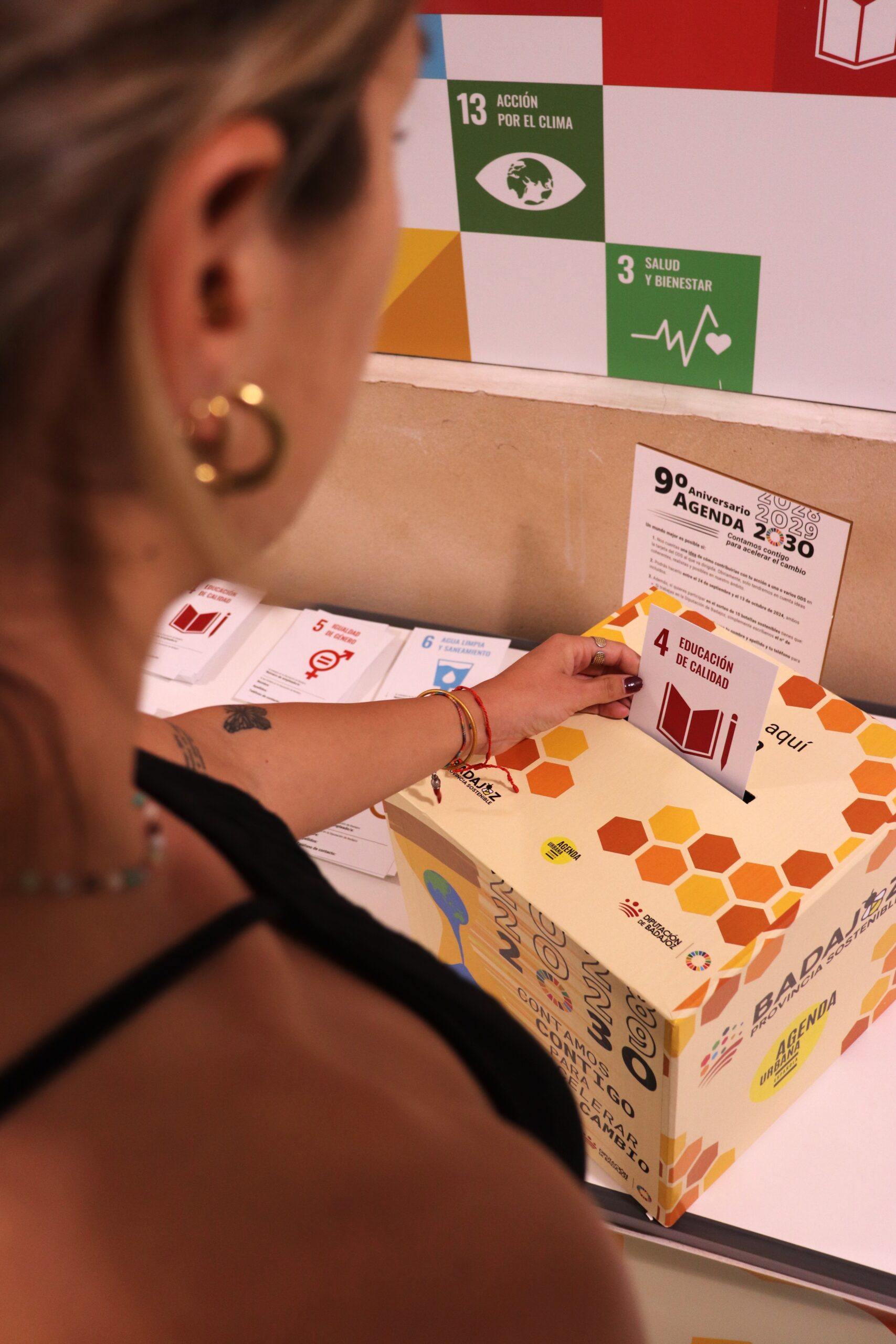
With the aim of gathering good ideas to contribute to the Sustainable Development Goals, suggestion boxes with cards identified with the 17 SDGs have been provided in 9 centers of the Provincial Council of Badajoz. These are accessible to both the general public and the staff of this Entity, allowing interested parties to write down their ideas for making this world more accessible.
The success of this project was such that a Secondary Education Institute in the province became interested in bringing this action to its center. This project invites young people to reflect, through the lens of the SDGs, on the current situation facing the world, and to identify what actions they could implement personally to contribute to achieving the global targets of the Sustainable Development Goals.
Furthermore, it is a project that not only identifies ideas that the Provincial Council of Badajoz could implement within its competencies—should it not be doing so already—but also serves as a way to understand which areas most concern the population and whether there is room for personal action to advance toward sustainability.
Project Classification:
- Conducting a situation analysis and a localization and implementation plan for the SDGs of the 2030 Agenda.
- Localization and implementation of the 2030 Agenda in the Local Entity.
- Alignment of existing plans with the SDGs of the 2030 Agenda.
- Work on specific SDGs.
- Identification of monitoring indicators.
- Establishing alliances to accelerate the SDGs of the 2030 Agenda.
- Dissemination/awareness-raising actions for the 2030 Agenda among the public.
Timeline:
Started on September 24 and ended on October 13.
SELF-ASSESSMENT BLOCK
- PLANNING. What were the objectives set for the project?
To raise awareness of the 2030 Agenda and the Sustainable Development Goals among the population, encouraging reflection on the current situation and possible alternatives to be implemented personally to contribute to achieving a more sustainable world.
- IMPACT. What are the positive impacts of the project?
High participation and a positive reception from citizens of all ages, with the contribution of ideas that are truly applicable in the province of Badajoz by the Provincial Council.
- INNOVATION. What are the most innovative aspects? What challenge/problem is addressed?
The innovative aspect of this project lies in the search for direct reflection by citizens on how to face the challenges our society presents when it comes to achieving sustainable development in the different areas addressed by the SDGs. Furthermore, it is presented as a direct line of communication with a Local Entity that can make possible the ideas that fall within its competencies and have not yet been implemented.
- METHODOLOGY. What methodology was followed for its implementation?
Ten boxes and ten sets of SDG cards were prepared for each of the tables where the project was deployed.
To make it even more attractive, a table runner was designed to decorate the table where the boxes are located, with the aim of capturing people’s attention and inviting them to participate—a communication tool in itself. These designs follow the branding of the II Sustainable Development Strategy 2024–2027, within which this project is framed.
As a method to disseminate this project to the public, a communication campaign was launched through the Entity’s internal channels (emails to Provincial Council of Badajoz employees) and external channels (the Entity’s social media). Additionally, 10 sustainable reusable bottles were raffled off to incentivize participation.
- CONDITIONING FACTORS. What conditions must be met for the project to be successfully reproduced (in a similar context)?
This project is perfectly replicable in environments interested in carrying out awareness and dissemination practices for the 2030 Agenda. It only needs to be placed in an environment accessible to the largest number of people, accompanied by a communication campaign to announce its launch.
In fact, the success of this project was such that one of the Compulsory Secondary Education centers in the province requested it, seeing it as a dynamic and attractive action for young people. It serves as a way to put the knowledge acquired about the SDGs into practice through internal reflection, which seeks not only to correctly identify the SDGs and their corresponding targets but also aims to identify what actions we can develop at a personal level in our closest environment to help contribute to the goals of the 2030 Agenda.
- REPLICATE/SCALE/TRANSFER What elements should be taken into account for the project to be replicated in another Local Entity? What resources are necessary?
The resources necessary to launch this project in another municipality are provided by the Provincial Council of Badajoz, which will be responsible for transferring the set of materials to the requesting locality. It is only necessary for the installation to be carried out in a location accessible to the largest number of people. It can be aimed at any type of population sector: associations, young people, the business fabric, etc.
- STAKEHOLDER INVOLVEMENT. Which local actors were involved in the project (citizens, third-sector organizations, private sector, academic field, etc.)?
Participants were mostly citizens, but there was also strong participation from employees of the Provincial Entity, each an expert in their field of action, who know how to detect, with technical knowledge, the factors that must be addressed to favor the achievement of the SDGs.
- How was this involvement achieved?
Thanks to the communication carried out for the project, both internally and externally.
- INTERNAL COORDINATION. How was the project coordinated internally within the Local Entity?
The project was launched and coordinated by the Presidency and Institutional Relations Area of the Provincial Council of Badajoz, together with 8 other centers of the Entity, which provided the space for the installation of the materials. The points where the project was carried out are:
- Provincial Palace of the Provincial Council of Badajoz.
- “Vaquero Poblador” Exhibition Hall of the Provincial Palace.
- El Hospital Centro Vivo
- Promedio Consortium
- Hernán Cortés University Residence
- Ecological Transition Area and Rural Development, Demographic Challenge, and Tourism Area.
- “Juan Vázquez” Professional Conservatory
- “Bonifacio Gil” Superior Conservatory
- OAR Central Services
- OAR Office in Mérida
- Were other institutions involved in achieving the set objectives?
No other institutions participated in the development of the project.
- RESULTS/MEASUREMENT. Have the project results been measured based on local indicators?
Final results were measured in relation to the level of participation:
- Total number of participants
- Total number of ideas collected
- Number of ideas collected at each of the tables.
- Number of ideas for each SDG.
- Number of ideas that fall within the scope of competence of the Provincial Council of Badajoz.
- Number of ideas on which the Provincial Council of Badajoz is already working.
- RELEVANCE. What is the suitability of the objectives and results? Is there coherence between the objectives set and the results obtained?
Following the development of the project, it can be determined that the objectives established at the beginning have been achieved. Not only has there been great participation, but ideas have been collected that can be implemented by the Provincial Council of Badajoz. Above all, it has been identified that the population has an increasing knowledge of the SDGs and is very sensitive to their environment.
- TRIPLE IMPACT: Is the project sustainable from an environmental, economic, and social point of view?
Given that the materials making up this project are already prepared and are fully reusable, and that it does not entail an economic cost for those entities wishing to implement it, while inviting the participation of all citizens without barriers, it can be considered a sustainable project from an environmental, economic, and social point of view.
- OBSTACLES: What were the main obstacles encountered in all phases of the project?
The location of the materials at a fixed point means not reaching the entire desired population due to the need to travel to the location to participate.
- CONCLUSION. Briefly explain the impact and utility of the project.
The SDG Challenge project has had a better reception than expected, to the extent that it has been extended to a Secondary School in the province. It has proven to be a dynamic and attractive activity, especially for young people, demonstrating that the SDGs have an impact on reality and that we are a key element in achieving the targets set by the 2030 Agenda.
It is an exercise in personal reflection while testing the population’s knowledge of the Sustainable Development Goals. It is important to identify not only the area that each person tends toward but also the targets they wish to achieve.
INFORMATION BLOCK
FURTHER INFORMATION.
View more casesLocal Entity name: Provincial Council of Badajoz
Province: Badajoz
Autonomous Community: Extremadura
Number of inhabitants: 664.970
Contact person: Ángela Emilia León Pizarro. 2030 Agenda and Innovation Coordinator. Email: rcortes@dip-badajoz.es
SDGs involved: