

12/05/2022
Social and business stakeholders, institutions and public administrations meet in Sant Feliu de Llobregat to address the challenges of the 2030 Agenda
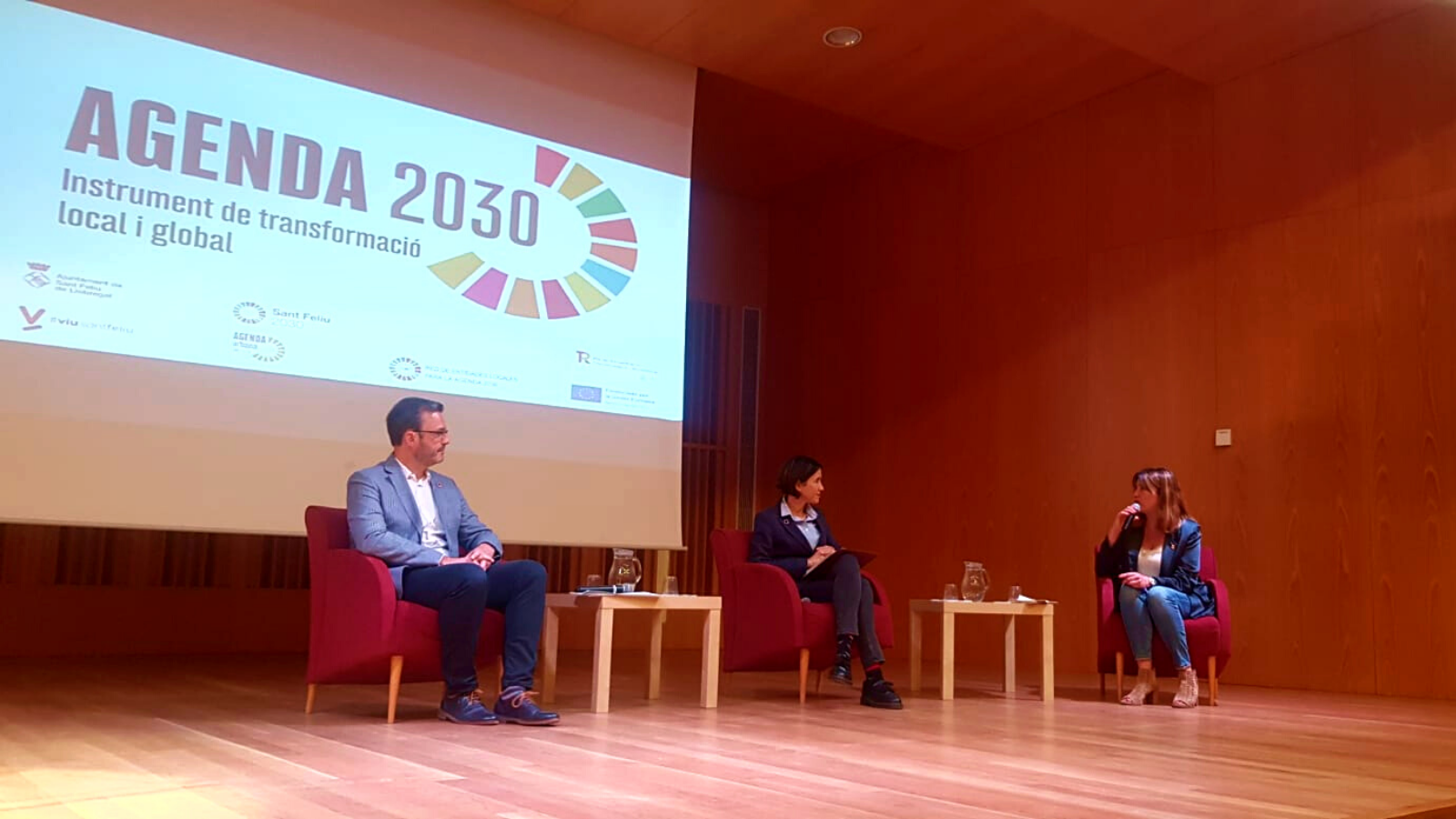
The Network of Local Entities for the 2030 Agenda continues to work towards a cross-cutting implementation of the SDGs. In this regard, a conference was held in Sant Feliu de Llobregat, organised by the City Council and in collaboration with the Network, where social and business stakeholders were able to exchange experiences and proposals with various representatives of local and central government. A meeting bringing together entities of different kinds, focused on addressing—through a broad perspective—the challenges of social, political and economic transformation required by the targets set out in the 2030 Agenda.
Lidia Muñoz, Mayor of Sant Feliu de Llobregat and host of the conference, and Enrique Santiago, Secretary of State for the 2030 Agenda, opened an event that addressed the essential role of local entities and municipalism in effectively driving actions that have a direct impact on citizens’ wellbeing.
Enrique Santiago wished to highlight the commitment to municipal policies as a useful instrument for implementing the SDGs. “We are about to sign an agreement with the FEMP that will allocate significant financial resources to the Network’s activities,” he stated.
Along the same lines, the Mayor of Palma and President of the Network, José Hila, underscored the role of the Network for its ability to attract investors and generate valuable cross-cutting cooperation among the different Local Entities. He also stressed the need to reduce bureaucratic hurdles and work on raising citizens’ awareness of regulatory frameworks in order to address the 2030 Agenda. This assertion was echoed by Núria Parlon, Mayor of Santa Coloma de Gramenet.
The role of the Urban Agenda as a catalyst for the 2030 Agenda was also highlighted. Thus, Carmen Sánchez Miranda, Head of the UN Office in Spain, pointed to its particular importance as an “accelerator” in building sustainable cities and communities (SDG 11).
The involvement of business and social stakeholders in the development of the SDGs was another aspect addressed during the local experiences panel. There, Joan Saliner, director of the company SET, expressed the need to foster a “structural change” in companies that incorporates “new values”. For his part, Xavier Bachs, President of the Associació CineBaix, highlighted the importance of strengthening collaboration between city councils and associations to reinforce local culture and its diversity.
The sharing of experiences continued with the participation of representatives from various Local Entities, addressing a range of issues. Aída Castillejo, spokesperson for Rivas Vaciamadrid City Council, highlighted the importance of citizen participation in improving public services—an idea further developed by Laura Pérez, Fourth Deputy Mayor of Barcelona, who highlighted the strategic plan for democratisation in the Catalan capital.
For his part, Robert Raga, Mayor of Riba-roja de Túria, emphasised the need for planning in order to achieve the objectives set for his city. In this regard, he highlighted the experience of the local “Eco-Riba” programme, a broad strategy covering environmental, cultural, social and heritage areas.
The final session of the conference was devoted to the implementation of SDG 11 (Sustainable Cities and Communities). “The Urban Agenda is a strategy that seeks to translate the SDGs into the reality of our towns and cities,” stated Sonia Hernández, Deputy Assistant Director in the portfolio of the Ministry of Transport, Mobility and Urban Agenda. Oriol Bossa and David Bote, Deputy Mayor of Sant Feliu de Llobregat and Mayor of Mataró, respectively, shared their pilot programmes on SDG localisation and were also responsible for closing the meeting.