

Good practices
On-Demand Public Transport Project
La Zarza Town Council
Summary
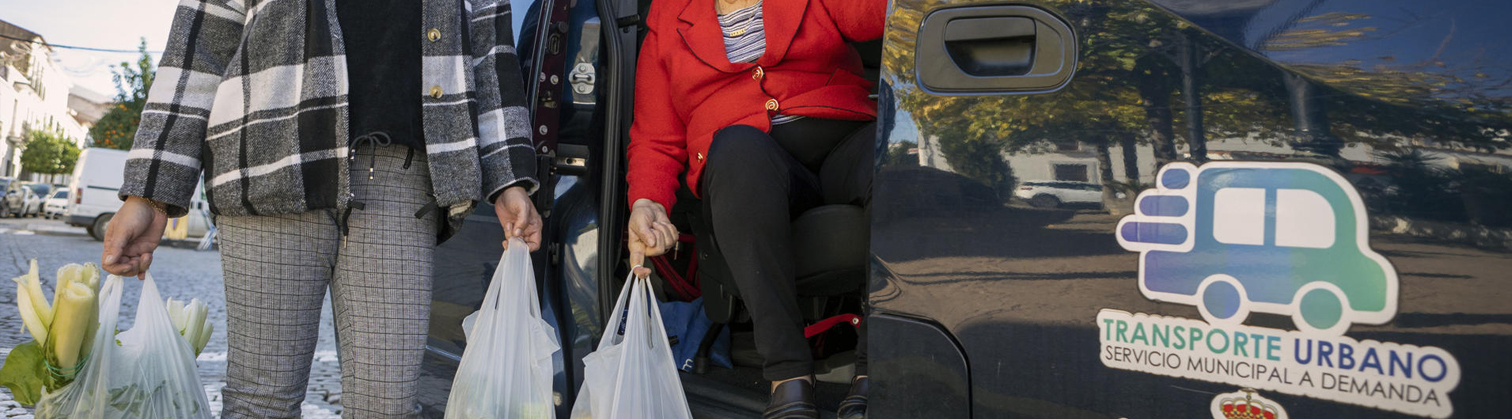
The free on-demand municipal transport service was launched by the Town Council in 2019. It operates Monday to Friday from 7:45 to 14:00 and meets the needs of people over 65 and people with reduced mobility of any age.
This is a mode of transport that is not yet very widespread in our country, especially in small municipalities.
The service is planned in a completely user-oriented way, as users must contact the operator/driver by phone to communicate their transport needs. It is provided on prior request and picks up and drops off passengers according to users’ needs.
It therefore represents an adaptation of public bus services to existing demand, so that there are no regular routes, but rather routes adapted to the user or groups of users.
Project Classification
This is a project that works on specific Sustainable Development Goals.
Timeline
From 2019 to date.
Self-assessment block
PLANNING What objectives were set for the project?
-Promote mobility and autonomy for older people or those with some type of disability.
-Combat depopulation.
-Ensure the population’s access to transport and improve their quality of life.
-Combat climate change.
-Encourage people to remain in the municipality and promote local employment.
IMPACT What are the positive impacts of the project?
With the launch of the project, autonomy and access to all basic services have been restored for people over 65 and those with reduced mobility, reducing dependence on family accompaniment and transport, and enabling those family members to enter the labour market. A phenomenon of returning descendants who had emigrated is even being observed.
INNOVATION What are the most innovative aspects? What challenge/problem does it address?
This initiative is primarily aimed at meeting one or more needs of the population in our area in relation to one or more of the pillars set out in the 2030 Agenda (People, Planet, Prosperity, Partnerships), mainly older people and those with reduced mobility.
METHODOLOGY What methodology was followed for its implementation?
At the start of the service, there was a gradual implementation period to assess citizens’ demand.
CONDITIONING FACTORS What conditions must be in place for the project to be successfully replicated (in a similar context)?
After 4 years since the service was launched, the number of users has gradually increased.
REPLICABILITY/SCALABILITY/TRANSFER What elements must be considered to replicate the project in another Local Entity?
-Financial availability.
-Long-term continuity.
-Municipal alignment and commitment to the SDGs.
RESOURCES What technical, human and financial resources have been used?
Costs associated with La Zarza’s On-Demand Urban Transport Vehicle
Initial investment costs
Vehicle €14,000
Annual fixed costs
Fuel + roadworthiness inspection (ITV) + insurance + workshop maintenance: €3,000
Staff costs /year
Wages and Social Security costs + driver insurance: €15,000
Subtotal Year 2022
Year 2019 €24,000
Year 2020 €18,000
Year 2021 €18,000
Year 2022 €18,000
Total invested: €78,000
STAKEHOLDER INVOLVEMENT Which local stakeholders have been involved in the project (citizens, third-sector organisations, private sector, academia, etc.)? How was this involvement achieved?
None.
Did the launch of the initiative involve local stakeholders outside the local authority?
Yes
If you answered yes to the previous question, could you indicate what process was followed to secure the involvement of the different stakeholders?
Agreements with Special Employment Centres to hire people with disabilities to work as drivers.
Is there any participation body or structure established with the different stakeholders?
Yes, a collaboration agreement has been signed with the different stakeholders.
RESULTS/MEASUREMENT Have the project results been measured based on local indicators?
Results have been measured by number of users / number of trips.
TRIPLE IMPACT Is the project sustainable from an environmental, economic and social point of view?
ECONOMIC IMPACT: On-demand transport has enabled users not to depend on another person to carry out everyday tasks or meet basic needs such as going to the Health Centre.
SOCIAL IMPACT: On the one hand, it has made it possible to turn users’ dependence into independence, facilitating the social inclusion of the affected population group. On the other hand, the council’s commitment for the driver role to be filled by a person with a disability has enabled the labour-market inclusion of unemployed people in vulnerable situations.
ENVIRONMENTAL IMPACT: In terms of caring for and improving the environment, on-demand public transport avoids unnecessary emissions by covering only the route of those who need it and combining all transport needs into a single vehicle and trip. It is having a positive impact on the effects of transport on the environment and climate by reducing greenhouse gas emissions.
OBSTACLES What have been the main obstacles encountered in all phases of the project?
The financial sustainability of the service.
CONCLUSION. Project impact and usefulness.
Mobility is an essential factor for achieving several of the SDGs; for example, it helps to achieve SDGs aimed at promoting employment and well-being and reducing inequalities and exclusion.
On-demand urban transport is also essential for the provision and use of health and care services; it facilitates users’ access—mostly women—to various local shops, contributing to the accessibility and affordability of goods for consumers.
Mobility through public transport is linked to a large number of SDGs. Since transport is an essential factor that enables several SDGs, its role in implementing the SDGs at local level must be fully recognised, always respecting the social and environmental objectives set with this initiative.
Information block
FURTHER INFORMATION
You can find more information at the following link:
La Zarza On-Demand Public Transport Programme
View more cases
Local Entity name: La Zarza Town Council
Province: Badajoz
Autonomous Community: Extremadura
Number of inhabitants: From 2,501 to 5,000 inhabitants
Contact person: Francisco José Farrona, Mayor
Contact phone: 924 366 001
Email: kikofarrona@hotmail.com
SDGs involved: