

Good practices
We are Future Rafelbunyol 2030
Rafelbunyol Town Council
Summary
“We are Future Rafelbunyol 2030” is a project that proposes a series of high-impact actions generated from within the youth ecosystem itself, which will drive the rest of the municipality’s relevant stakeholders and the public.
With this project, the aim was to build—through a series of phases—actions that would raise awareness and sensitise secondary and upper secondary students, and the teaching staff who accompany them, about the SDGs and the 2030 Agenda, with an indirect impact on the rest of the public.
Within the project, different actions were carried out to raise awareness of and promote the SDGs of the 2030 Agenda at local level, aimed at this group, which plays a fundamental role in the transformation towards a more sustainable municipality.
Project classification
It is a project in which different outreach/awareness-raising actions on the 2030 Agenda were carried out among the public.
Timeline
From 26 March 2023 to 20 May 2023
Self-assessment block
PLANNING What were the objectives set for the project?
The main objective was to foster leadership among groups of young people and adolescents aged 12 to 18, accompanied by as many IES Rafelbunyol teaching staff as possible to support their involvement in the process, through a series of actions and challenges to activate the young population with an indirect impact on the public in general, in order to promote the principles of the SDGs and the 2030 Agenda in the municipality. To this end, awareness-raising and promotion actions on the 2030 Agenda and the SDGs were carried out for this group, which plays a fundamental role in the transformation towards a more sustainable municipality.
INNOVATION What are the most novel aspects? What challenge/problem is addressed?
This initiative is mainly aimed at meeting one or more needs of the population in our territory in relation to one or more of the pillars set out by the 2030 Agenda (People, Planet, Prosperity, Partnerships).
Which target population is it aimed at?
Young people aged 12 to 18, with an impact on the entire public.
Is the initiative currently being implemented?
No, it has already ended.
METHODOLOGY What methodology was followed for its implementation?
The project is built on a methodology structured into 3 main phases: Awareness – Activation – Participation. Awareness: an outreach and scientific workshop, where the main issues of climate change were presented and how solutions can be structured to mitigate it. In addition, emphasis was placed on the importance of the 2030 Agenda as a tool for transformation towards sustainability and on how they can participate in this global process with local impact. In the activation phase, the challenge was carried out, generating a positive impact on the rest of the students as well as on the public of Rafelbunyol. Both phases were designed with a participatory approach, involving students’ participation in the activities to be developed during them. In the participation phase, a hackathon was held in which young people and adolescents were able to be part of the change, proposing innovative ideas to improve Rafelbunyol in terms of sustainability. These three phases are directly related to each other, generating a youth participatory environment that enables building and transforming through active participation and not only consultative participation.
CONDITIONS What conditions must be met for the project to be successfully replicated (in a similar context)?
Engage young people with the support of the consultancy, teachers and funding.
REPLICABILITY/SCALABILITY/TRANSFER What elements should be considered to replicate the project in another Local Entity?
Good relations with the school management team, committed technicians, and a lot of communication/outreach.
RESOURCES What technical, human and financial resources were used?
The project amounted to 25,880, of which 20,000 was funded by the Generalitat. This amount includes in-house staff, consultancy (Hackathon staff + Climate Fresk + training + creative work), digital and physical materials, and an audit.
STAKEHOLDER INVOLVEMENT Which local stakeholders have been involved in the project (public, third-sector organisations, private sector, academia, etc.)? How was this involvement achieved?
Teaching staff
Briefly, what role has each one played or is playing?
Once trained, the teaching staff took part in the implementation of two of the project activities: the scientific outreach workshop and the Hackathon.
Could you indicate what the main actions developed by the initiative have been?
Within the project, different actions were carried out to raise awareness of and promote the SDGs of the 2030 Agenda at local level, aimed at this group, which plays a fundamental role in the transformation towards a more sustainable municipality. To this end, five activities were carried out:
– A week of communication and awareness-raising on the 5 “Ps” of the SDGs, with impactful social media messages about the SDGs for each P, reaching 605 people: 522 on Facebook and 3,500 on the municipal WhatsApp. The project and activities were promoted in the press, with a total of 7 publications in digital newspapers.
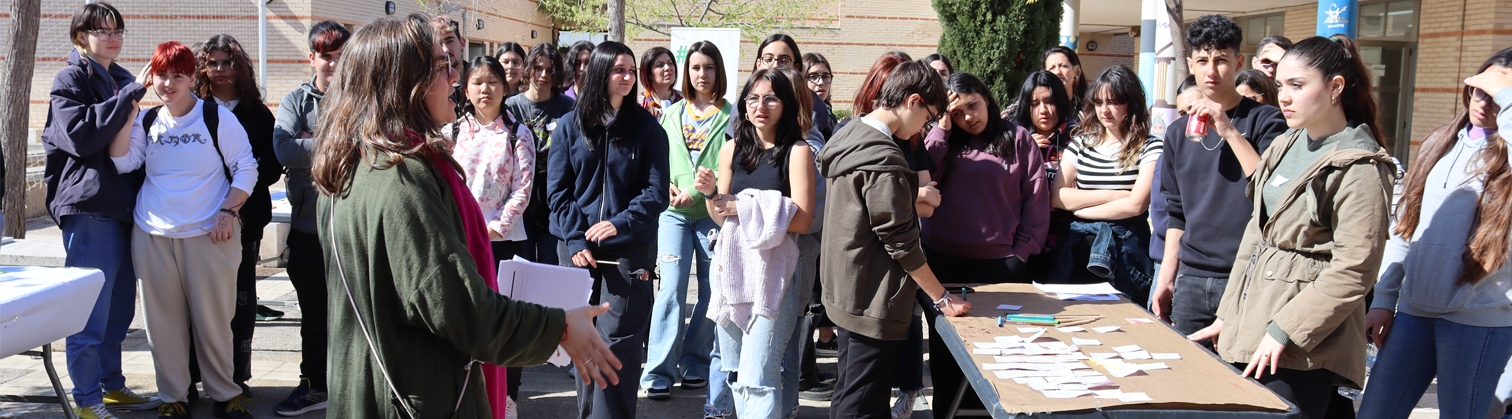
– Outreach day, where a scientific, creative, collaborative and playful outreach workshop was held for the Secondary and Upper Secondary Education courses at IES Rafelbunyol, with the aim of raising awareness and educating about climate change and the 2030 Agenda: THE CLIMATE FRESK, for which IES Rafelbunyol teaching staff and Town Council technical staff were trained.
– Student hackathon, where 17 challenges were proposed, one per SDG, and in this process the students, organised into teams, developed ideas that could be implemented in the municipality to address the identified challenges. The activity was carried out with 17 student groups, with a total of 109 students, accompanied by 10 teachers and 10 external technicians (including 1 technician from Rafelbunyol Town Council). It has been the workshop with the most students held in a Spanish secondary school. 425 ideas were debated and 17 solutions were delivered.
– TikTok Challenge: To encourage public participation in the project and promote the SDGs in the locality, a TikTok Challenge was carried out using the mobile app “The Good Goal”, which challenged us to be more sustainable in our day-to-day lives. An app where we could measure progress in reducing carbon footprint, water consumption and waste generation in a simple and fun way. The app was linked to the Instagram social media challenge, and Rafelbunyol Town Council’s social media channels were used to encourage the rest of the public to join the challenge, generating a panel of posts and creative assets around the challenge, while also running a campaign through social media with attractive prizes for participating.
– Training: Both teaching staff and Town Council technical staff received SDG training over two days.
PARTNERSHIPS Have other institutions been involved in achieving the set objectives?
Yes
If the initiative has had the collaboration of other levels of government, how was that collaboration specified?
We received a grant to fund or co-fund the initiative.
Has the launch of the initiative involved local stakeholders outside the local corporation?
Yes
If you answered yes to the previous question, could you indicate what process was followed to secure the involvement of the different stakeholders?
Support was requested from IES teaching staff through meetings with the management team.
Is there any participation body or structure established with the different stakeholders?
There was none; they were only invited to lunch as a thank-you.
RESULTS/MEASUREMENT Have the project results been measured based on local indicators?
Count of posts, participants and emissions reductions in the challenge app.
TRIPLE IMPACT Is the project sustainable from an environmental, economic and social point of view?
The 2030 Agenda sets out the guidelines that must drive the building of the future of societies, based on the pillars of economic, environmental and social sustainability. The consequences of the Covid-19 crisis and its impacts on the social, economic and environmental dimensions have accelerated the need to manage territories under the principles of the 2030 Agenda and the SDGs, in order to mitigate these effects and achieve more sustainable societies that do not compromise future generations or the development of territories.
OBSTACLES What were the main obstacles encountered in all phases of the project?
Participation in the challenge was difficult, despite outreach and prizes for taking part.
CONCLUSION. Project impact and usefulness.
The “We are future Rafelbunyol 2030” programme has generated a youth participation environment that enables building and transforming through active participation and not only consultative participation.
Rafelbunyol Town Council has identified the need to move towards a more sustainable development of the municipality based on the implementation of the SDGs, making it necessary to create an ecosystem in which young people and adolescents feel their leadership in transforming their territory and internalise that their actions today will be the consequences of the future.
Information block
FURTHER INFORMATION
You can consult the Town Council website:
https://www.rafelbunyol.es
View more cases
Local Entity name: Rafelbunyol Town Council
Province: Valencia
Autonomous Community: Valencian Community
Number of inhabitants: From 5,001 to 10,000 inhabitants
Contact person: Marta Fenollosa. Municipal Technician
Contact phone:961 410 100
Email: martfeno@gmail.com
SDGs involved: